With that in mind, take a look at this climb "down" the stair steps. The music is a bit "cheesy" for the grand efforts going on but it was one of the first videos I made with my movie maker program and, well, the excitement of editing a complete video, overcame me.
Sunday, October 28, 2012
Indian Stairway Video
Back in 2011 I shot a short video (59 seconds) of my daughter and friend negotiating the famous Indian Stairway of the Red River Gorge. In all the versions of the Swift journals describing the terrain and landmarks, an Indian stair steps or stairway is mentioned. The site of this unusual, obviously man-made cliff access, is in the heart of some of the most breath taking landscapes anywhere. In Swift's journals the steps are supposedly near at least one of his hidden "mines."


Sunday, October 14, 2012
Was John Swift a Pirate?

According to the legend of John Swift, in his own words, claimed he was a captain of a ship and owned a company of sailing ships. He says he was a successful business man transporting merchandise from both England and the seas around Cuba. Though he never claimed to be a pirate there are some modern day Swift researches that believe he may well have been a one.
In one version of the supposed journal Swift wrote down himself he gives a brief description that he and some others in his company sailed to Cuba. Now Swift worked off the Virginia and North Carolina coasts and though the so called golden age of pirates was several decades before this time, piracy on the high seas has never stopped even until this day. Swift never actually states under which flag he sailed but it would likely have been the British or Colonial flag. His venture to Cuba also meant that he was comfortable sailing into Spanish waters. The British and Spanish, though hostilities had been resolved between the two nations, still moved in their separate domains. The Spanish having taken control of South America and the British moving to take North America. Britain by Swift's time had become enemies with France. This resulted in the French and Indian alliances trying to hold back the westward expansion of the British via colonial expansion.


Strangely enough, most of the larger treasure discoveries of the Appalachia country actually turn out to be Spanish silver coins, the ones like found on so many ship wrecks of the Spanish ships that ferried the riches from Columbia and Peru. Some of the finds have be quite impressive. These coins were the type most commonly captured by pirate ships marauding the American coastline all the way to the Florida Keys.
Bill Gibson of Elkhorn City, Kentucky made an astonishing discovery several years ago. While searching, following clues and by pure chance Bill stumbled upon a cache of buried coins somewhere on the Pine Mountain in that region of the state. The coins are not British counterfeits. They are Spanish pieces of eight and some think they are counterfeit. Whether they are or not, the fact that real coins of silver were discovered hidden in a rock shelter/cave somewhere in the very region that Swift says he was during the mid 1700's is truly amazing.
 One thing we all seem to forget about in the drama and excitement in following the Swift legend is that Swift and his party of men were certainly committing a high crime. So one can logically conclude that perhaps Swift, if he really existed, was not a very truthful person and capable of other crimes beside this obvious one. Perhaps Swift and his company of men acquired their silver from Spanish ships and simply escaped into the mountains to hide their plunder and not be hanged. Of course, we will probably never know about this and perhaps I and others are simply over extending our imagination regarding the Swift lore. One thing is for sure, Bill Gibson found buried treasure and those silver coins never got there by themselves!
If you are new to this blog site, I invite you to take a look around in the archives of previous posts located over here on the right side this page. You will find lots of great information and photographs. The subjects are varied and not all Swift related but are uniquely Kentucky.
And if you would like to read my novel based on the Swift legend you can get your copy here. It's a fun and adventurous romp through history and modern day Kentucky.
Sunday, September 30, 2012
Walking Thunder

I am writing this entry on behalf of my friend Ed Whiting of the Crow Creek Reservation in South Dakota.Ed, also known as Walking Thunder, is a Dakota and craftsman of the traditional items of the Dakota people of the plains. I had the good fortune to meet and become acquainted with Ed and his lovely wife, Bea who is a Lakota Native American. Ed is a true Dakota that has great talent and great insight. Utilizing his skills passed down through his ancestors I was surprised a couple of Christmas's ago with an amazing handcrafted bow complete with quiver and arrows. He carefully crafted the bow from Osage Orange wood, while the arrows are made from cherry saplings, with bone points. The quiver is made of Buffalo hide and the sheath for the bow is made of tanned Elk hide. Ed makes a few items to sell occasionally by special order. This is a supplemental income for him as they, like most reservation people live in an area with little opportunities for employment.
 |
| Ed and Bea Whiting with my daughter Allison on the right |
Here are a few examples of some of the traditional crafted items that are unique to the plains people. If you would be interested in having something made by Ed, I am sure he would be willing to work with you to produce the item for you. With that said, it could be awhile before Ed can do any work for you now. He has been in the hospital for many months trying to recover from a serious surgical mishap earlier. This has been both exhaustive and costly on him and Bea. They have endured a great hardship for that last few months.


Ed spends many of his summers on his farm providing camps for young people who wish to learn the ways and traditions of the Lakota and Dakota peoples. He has missed last year and this year is not shaping up to well either as Ed recovers from the many surgeries he has bravely undergone.
I know this; Walking Thunder is a wise and talent man that truly represents the best in all people. If you ever plan a trip to South Dakota and would like to visit Ed, let me know I will let him know you're coming and give you directions. In the meantime, take a look at these items and if you are interested why not get Ed to make you something truly amazing.
Sunday, September 16, 2012
Primitive Skills
 |
| Hand, coiled pottery-without a wheel |
I do have an exception to my very general and not so strict rule. In one of my favorite places, the Red River Gorge, at the mouth of Gladie Creek on the Red River on September is the annual Living Archaeology Weekend. The event is held on the grounds of the US Forest Service Visitor Center and is At the annual primitive crafts weekend held each year at the Visitor Center area on Gladie Creek in the Red River Gorge visitors can really see some amazing skills and crafts. I found it very interesting of all the different types of primitive and pioneer crafts that are demonstrated and exhibited. This is an annual event I am adding to my list to attend this year. Here are a few that caught my eye when visiting a previous event.
 |
| Add caption |
 |
| Primitive drills using chipped flint would drill through rock! |
 One item being demonstrated was of particular interest to the kids. Primitive drills made from a sharpened piece of flint attached to a straight stick used with a string of leather or sinew would easily drill through wood and stone-just like a modern electric drill. This type of drill was around and used by Natives for centuries. I had never actually seen one used and here at this event kids were using them quite effectively.
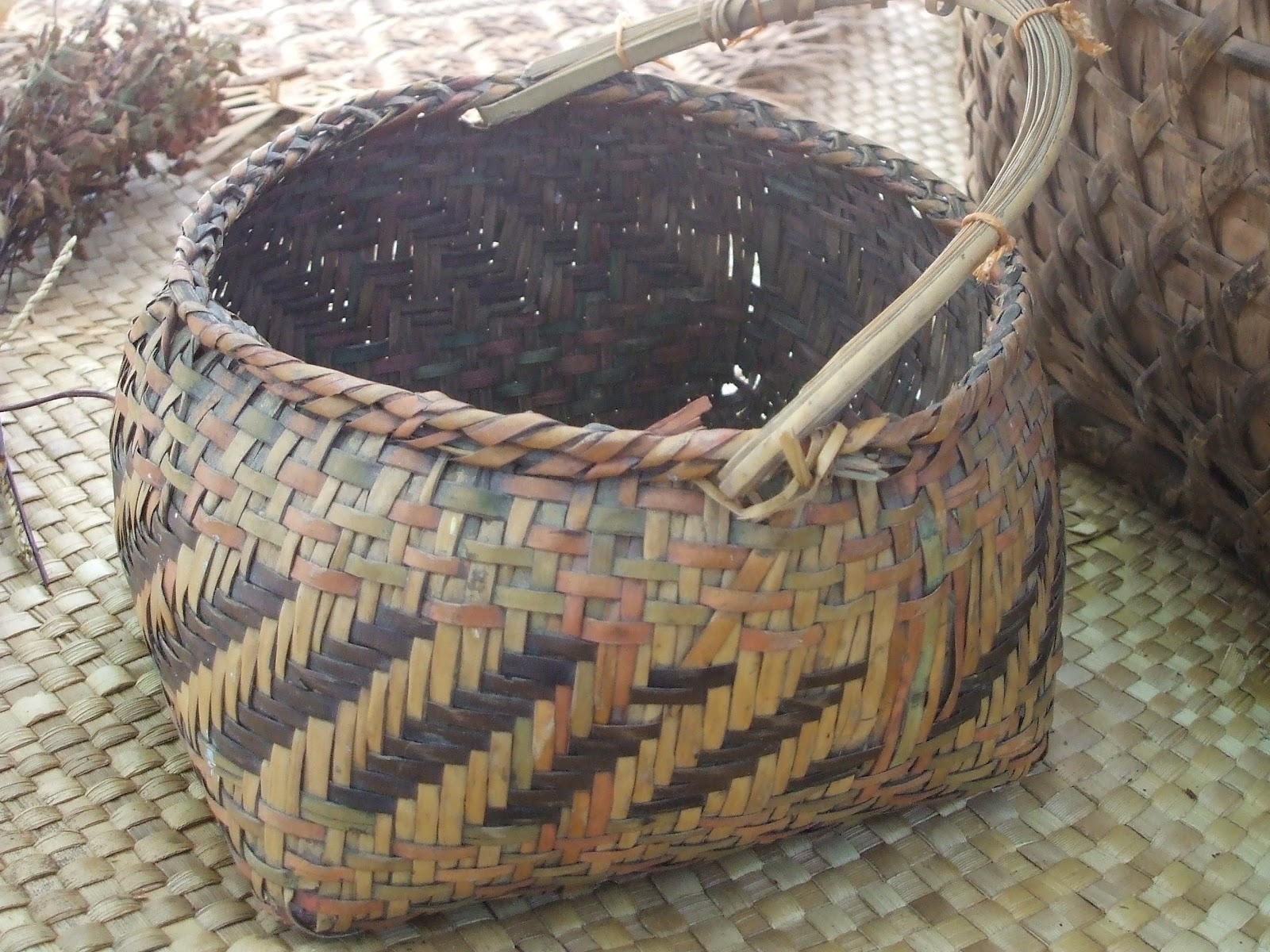 |
| Baskets of excellent quality |
 |
| Demonstration of the Cherokee thistle dart |
 |
| Flint knappers chipped away |
 |
| The quality of the chipped stone tools was excellent |
 |
| This point was made from quartz from North Carolina |
 |
| Leggings for dances and ceremonies were made |
 |
| Tanning and hide preparation |
 |
| Nearly every exhibit had demonstrations going on continuously |
 |
| Medicinal plants anyone? They had them. |
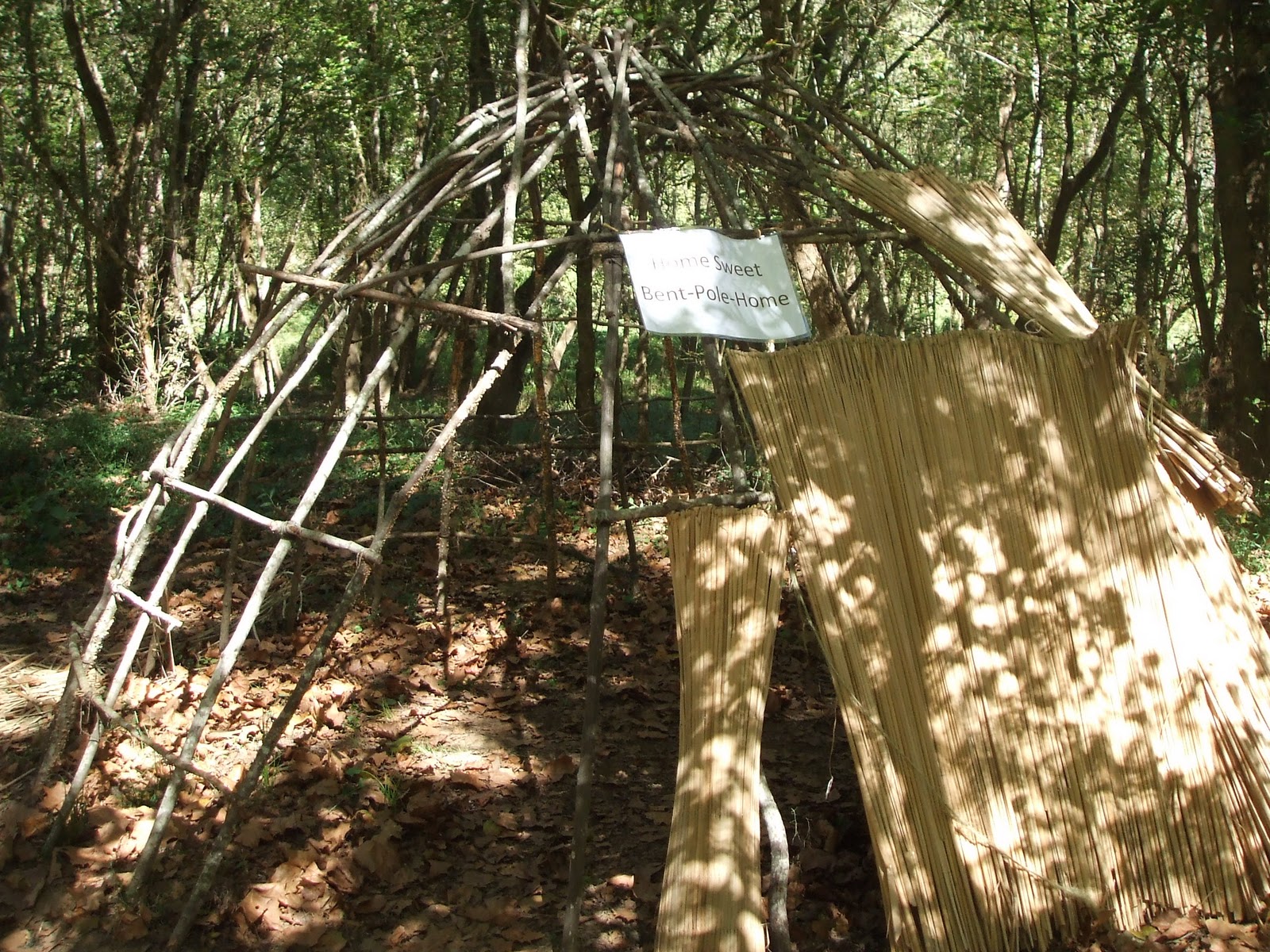 |
| One of my favorites was the on going construction of this cattail shelter constructed with bent saplings and cattail mattes.
This years event is coming up September 22 and will be held at the Gladie Visitor Center in the heart of the Red River Gorge.
|
Demonstrations are on going all day long the days of the event. Some exhibitors do sale some items that they demonstrate or are making right there on site.
There were baskets made from willow bark. All sizes and shapes and the bark had been dyed using natural dye substances to produce different colored materials to be woven together.
The Cherokee people from North Carolina were making thistle darts. The ripened thistle head from a bloom produces a light fluffy cotton like fiber. These fibers are woven around a sharpened slender stick. The fiber expands to loosely fill the cane dart gun and can be blown several yards with deadly accuracy.
Of course one of my favorites are the flint knappers.
Wednesday, August 29, 2012
This and That
I'll be taking a break on this blog post this Labor Day Weekend but will be back on a regular bi-monthly schedule starting September 16th. We hope that you enjoy the blog posts and photographs we gather from around our beautiful state. There are so many things to see and do and it is the upcoming fall festival season. Practically every weekend from now until Thanksgiving communities are having their annual festivals. These are a lot of fun and some are quite unusual. Here is a link to give a preview of upcoming events.

If you enjoy reading my blogs and have suggestions or ideas of places and people, please tell me in the comment section below. I promise I will get back to you and keep in mind all comments must be approved before they are actually posted. So, if you don't want you comment posted, but would like to contact me, well, the comment section is the best way.

 My book is still available from this secure link.
 Kiowa Scott Muncie who guest posts on this site will have a new article with photographs in the days ahead. He has an amazing collection of rock carving photos. You can visit his Facebook page here.
Coming up in the next blog post will be devoted to a very unusual special event held annually in the Red River Gorge and the heart of Swift country! Coming September 16! Also, I will be signing books Friday, August 31 at the Salyersville Public Library from 10-2. If you are in the area stop by and say hello.
Sunday, August 19, 2012
We called it the Light House

There are so many version of the Swift Journal containing many landmarks that it can be downright confusing sometimes. Over the years, sifting through many variations there are few landmarks that seem common to all the different versions. One notable is the famous 'light house.' Swift in describing one of the areas of his 'mines' claims to look across the valley to cliff with a hole in it. "The slope across the hills west there is a big rock that looks like a buffalo rock. We cut our names on it: Swift, Monday, Greser,Jefferson and others. You can stand on top of this hill above buffalo rock and look west through the hole in the top of the cliff and see the sky beyond. We called it the 'lighthouse.' Not far from the drying ground west we carved turkey tracks under a cliff pointing backwards to the mine." *

The Red River Gorge country is famous for the numerous natural arch formations in the sandstone cliffs of the region. Of the hundreds in the area, two are more famous than all the rest and probably more visited each year than all the rest. One, of course is the famous Natural Bridge located near Slade, Ky. The second most notable arch is the beautiful Sky Bridge located on a ridge that overlooks the confluence of "Swift" Creek and the North Fork of the Red River.
Yes, right there in the heart of the Swift country overlooking the very creek that is named for the legendary character are the landmarks described in his journals which tell of the amazing riches that supposedly still remain hidden somewhere in the wilds. No wonder this area became ground zero for the search decades ago. Since that time the search has expanded to other regions of the state and even to other states. All have similar clues and landmarks.
 The whole region of the Red River country is truly remarkable and certainly lends itself to all kinds of possibilities of discovery.
From the unofficial entrance to the gorge area, the Nada Tunnel, to the magnificence of the majestic Sky Bridge the landscape is wondrous.
On this visit to Sky Bridge I discovered among the many names and symbols carved on the soft sandstone rock yet another turkey track pointing directly up the Swift Creek valley. With no way of knowing the age of the carving there is little evidence of anything other than someone at sometime took the time to carve a turkey track without any other information. Was it a traditional symbol pointing the way to something? The opposite direction from the Swift Creek side lies a huge rock cliff line with ledges, overhangs and boulders just like Swift described. Could the Sky Bridge be that light house, Swift mentioned? Remember, it is on Swift Creek that the famous Rock Bridge is located which has another turkey track carved on the top of that bridge as well. And Swift mentions a rock bridge that spanned a creek and he and his companions passed by that unusual formation headed for their precious mines.
 Aside from the search for the hidden treasure, the Nada Tunnel itself is a marvel. Built in a mere nine months in 1910-11 it was built for the sole purpose of hauling the valuable timber from the remote gorge region by locomotive. Drilled by hand and steam drills the rock was blasted away with dynamite. One man was killed during the construction. The tunnel provided a quick way to transport the timber wealth to the then largest sawmill in the world located at Clay City, Kentucky.
 On every trip I make into the Red River Gorge, it is always a thrill to drive through the Nada Tunnel passing by the cool spring that to this day furnishes fresh, mountain water to many folks in the immediate area. The spring has been there as long as I can remember and always tests as safe, pure water.
The mines may never be found. They may not even exist. But then again, there have been some discoveries of silver coins in various parts of the region. So whether these discoveries are connected to the Swift treasure or not will probably never be known. We do know that there in fact are 'light houses' located in the search zone.
*From a copy of Swift's Journal sent to C. E.Henson March 5 , 1962. The following handwritten note was written in the margin: "Mr. Henson here's a copy of Swift's journal. I will contact you when I get to Louisville next trip – I want to see "settlers of SW Virginia." The note was signed by O.S. Green.
*From a copy of Swift's Journal sent to C. E.Henson March 5 , 1962. The following handwritten note was written in the margin: "Mr. Henson here's a copy of Swift's journal. I will contact you when I get to Louisville next trip – I want to see "settlers of SW Virginia." The note was signed by O.S. Green.
Sunday, August 5, 2012
High Rock Carving


The unusual carved rock is now housed in the Red River Museum located at Clay City, Kentucky and is on prominent display.
Subscribe to:
Posts (Atom)
Swift Interview
Just a quick update as promised. The Swift interview will air May 21 at 8:00 PM on KET. The last entry on this site covered the intervie...

-
 For those folks interested in archaeology and/or geology you no doubt have considered the flint (called chert by geologists) that all th...
 -
 by Kiowa Scott Muncie This is not your usual post concerning Swift, his mines or even his hidden silver, but better yet, about a ...
 -
 One of the strangest rocks on display is found in Manchester Kentucky. For it is here that the Marked Rock is preserved and on display...