
Saturday, May 14, 2016
Swift Interview
Just a quick update as promised. The Swift interview will air May 21 at 8:00 PM on KET. The last entry on this site covered the interview and location of the taping. If you are interested in learning about the treasure and see yours truly yacking about the legend, tune in on May 21st.


Wednesday, April 27, 2016
Swift Interview
It was a very interesting day April, 26. A production crew from KET (Kentucky Educational Television) taped a segment of yours truly discussing the background and lore around the famous legend of John Swift and his mysterious silver mines and treasure. I met up with the crew at Sky Bridge in the Red River Gorge and after a short hike down beneath the rock arch they video taped me discussing what I have come to know about the search and treasure.
Basically, the short segment will focus more on the legends background and how long the story has been around rather than giving clues on searching for the supposedly hidden treasure. I hope that viewers will take away the importance of the history of the legend and not the debate whether silver and the mines ever existed. As I note in the interview, the beauty of the whole legend is just how long the search has been going on and how the legend originated at least as early as the first famous pioneers entered the wilderness that was to become Kentucky.
It could not have been a better day for being in the great outdoors. And it is always great enjoyment for me to get back into the Red River country. The spot chosen was interesting enough near the mouth of Swift Creek which takes its name from the legendary character and tale of lost treasure. It was a fun experience and certainly a chance to acquaint new folks with the oldest treasure legend in Kentucky. At this time I do not know the air date of the episode but was promised I would be notified in advance. Hopefully, I will have enough advance notice to pass along the air dates here to those who may be interested.
And, of course, to all those serious and dedicated searchers out there that happen across this site I did the interview from the perspective that my interest and passion for the treasure story is the story itself. I admit that there are many out there still searching every spare moment and they know far more details and clues than I do. But, as I understand, this short episode will just provide and overview of the famous legend.
Thanks for stopping by the site and please browse through past posts. Many of them give more details and clues about the lost treasure as well as many other interesting places in Kentucky.
And if your are interested in a good story about the legendary treasure, check out my book Swift at Booklocker.com. It is a safe and secure place to by many great books that will promptly be shipped to you. You can also find the book at most popular online sites. The book can also be purchased through most bookstores. Thanks for stopping by.
Basically, the short segment will focus more on the legends background and how long the story has been around rather than giving clues on searching for the supposedly hidden treasure. I hope that viewers will take away the importance of the history of the legend and not the debate whether silver and the mines ever existed. As I note in the interview, the beauty of the whole legend is just how long the search has been going on and how the legend originated at least as early as the first famous pioneers entered the wilderness that was to become Kentucky.
 |
| KET production crew setting up for interview |
And, of course, to all those serious and dedicated searchers out there that happen across this site I did the interview from the perspective that my interest and passion for the treasure story is the story itself. I admit that there are many out there still searching every spare moment and they know far more details and clues than I do. But, as I understand, this short episode will just provide and overview of the famous legend.
Thanks for stopping by the site and please browse through past posts. Many of them give more details and clues about the lost treasure as well as many other interesting places in Kentucky.
And if your are interested in a good story about the legendary treasure, check out my book Swift at Booklocker.com. It is a safe and secure place to by many great books that will promptly be shipped to you. You can also find the book at most popular online sites. The book can also be purchased through most bookstores. Thanks for stopping by.
Monday, February 1, 2016
The Book
 |
More about the book and many interesting places and people are available on this blog site.
Wednesday, December 9, 2015
Mound People
It is perhaps one of the hottest days of the summer. And I am in western Kentucky and it seems to me to be even hotter. The trip is worth the heat and humidity though because I am visiting a very unique park. This park is devoted to the civilization that once occupied the Mississippi valley and central North America. Today's visit is to Wickliffe Mounds State Historic Site.

Located on the bluffs overlooking the Mississippi River in western Kentucky the park is the site of a once thriving small community of people that lived at the site around 1100 to 1250 A.D. or about 750 years ago. According to archaeological evidence the small village lasted about 150 years. There are four main mounds that comprise the park and each one was for a different purpose. Some were for burial of loved ones, like our cemeteries of today Others provided platforms for houses of person of status such as leaders of the community. And other earthen mounds appeared to be for ceremonial and business purposes.
Wickliffe Mounds has an archaeological excavations site of the apparently living areas of some of the community. Tools, foods they ate and how their homes were built and arranged have all been gleaned from the excavations of the site. These excavations were conducted in the 1930's by the then owner Fain King, an amateur archaeologist. Mr. King opened and operated the excavations as a tourist attraction. In 1983 the property was turned over to Murray State University which operated the site as a research center. In recent years Wickliffe Mounds was designated as a historic site and became part of the Kentucky State Park System.
We know understand that this prehistoric village was part of the Mississippian culture that thrived in the central part of North America. The people that lived in this small settlement were part of a bigger society that occupied the entire region with the largest city of the Mississippian people living in Cahokia Mounds in southern Illinois. Cahokia mounds built the same type of earthen mounds as the Wickliffe people except on a much larger scale.It is thought that as many as 20,000 people lived in the city. Wickliffe Mounds was simply a small satellite community much like small communities today are arranged on the outskirts of large cities.
The mound builders had developed an elaborate social structure. Agricultural practice of raising corn and other cultivated crops the Mississippian people were able to produce a surplus of food. With extra food being available specialized skills became possible just like our society of today. The mound builders transition their society from a hunter gatherer people to agricultural.
The open excavations are protected inside the main museum building along with a variety of exhibits that explain many of the tools and materials used in the everyday life of the Wickliffe people. The site is unique among Kentucky State Parks in that it is the only park completely dedicated to a prehistoric culture. The park also includes a small gift shop and picnic shelter and facilities.
While in the area on this visit a took a short ride over to the Ballard County wildlife management area and got a glimpse at some of the cypress swamps and waterways that are in this lowland region of Kentucky. As I am from Eastern Kentucky where the land is hilly to mountainous it is fascinating to me so see this totally different type of landscape in our beautiful state. Western Kentucky has a lot of interesting history and places to enjoy.

 |
| Park grounds with museum building |
Wickliffe Mounds has an archaeological excavations site of the apparently living areas of some of the community. Tools, foods they ate and how their homes were built and arranged have all been gleaned from the excavations of the site. These excavations were conducted in the 1930's by the then owner Fain King, an amateur archaeologist. Mr. King opened and operated the excavations as a tourist attraction. In 1983 the property was turned over to Murray State University which operated the site as a research center. In recent years Wickliffe Mounds was designated as a historic site and became part of the Kentucky State Park System.
 |
| Artist rendering of how mound may have been used |
 |
| Inside the museum at Wickliffe Mounds State Park |
The open excavations are protected inside the main museum building along with a variety of exhibits that explain many of the tools and materials used in the everyday life of the Wickliffe people. The site is unique among Kentucky State Parks in that it is the only park completely dedicated to a prehistoric culture. The park also includes a small gift shop and picnic shelter and facilities.
While in the area on this visit a took a short ride over to the Ballard County wildlife management area and got a glimpse at some of the cypress swamps and waterways that are in this lowland region of Kentucky. As I am from Eastern Kentucky where the land is hilly to mountainous it is fascinating to me so see this totally different type of landscape in our beautiful state. Western Kentucky has a lot of interesting history and places to enjoy.
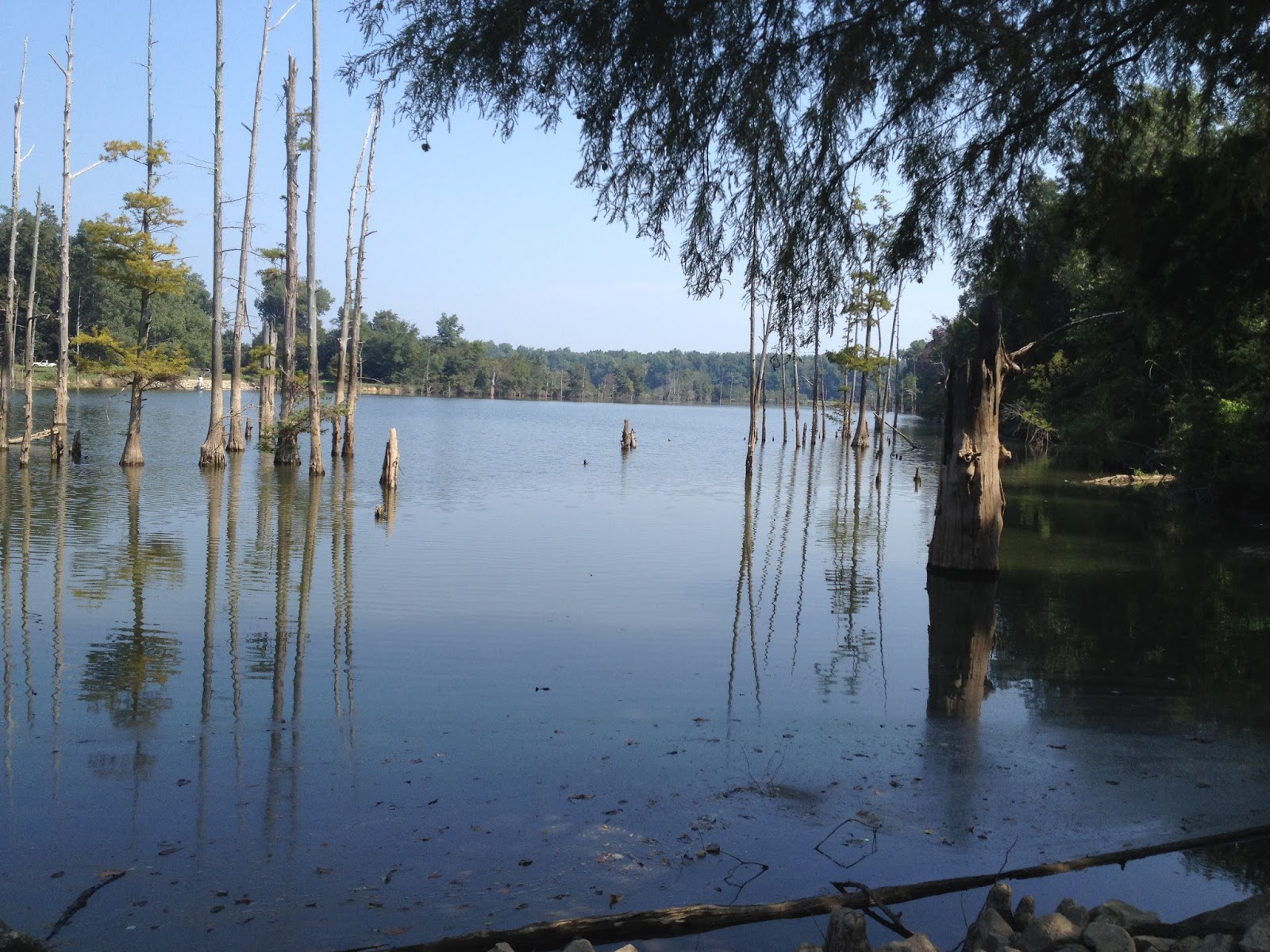 |
| Cypress grove in Ballard County, Ky |
Monday, August 31, 2015
Swift Blog Update
Hello to all. Thanks for stopping by my blog site. I hope you find articles and information that is interesting and helpful in your research or entertainment. I have not posted in some time now but rest assured I am working on some new posts for the near future.
As you may have figured out by now my interest in the geology and unique things of Kentucky is the main focus of this blog site. There are many other great sites that equally showcase amazing things from around out state. Some of my favorites are listed in the column on the right side of this page. You will also find links to my book publisher. And there you go, another reason for this site. I do want to promote my book "Swift." I have from time to time promoted the book as a blog entry. Well, I am going to do that again in this post.
"Swift" is a historical novel that is a treasure hunt for the legendary lost silver mines of John Swift. I believe this to be the oldest legend of Kentucky that predates statehood and is intertwined with known historic figures and events. For example, James Harrod, the pioneer who founded the first settlement in the Kentucky wilderness disappeared while searching for the mysterious silver mines. John Filson, who wrote the first book about Kentucky filed land claims that in the records declared that the lands he claimed contained the silver mine workings of Swift.
From those days until this very day people have searched the lands of Kentucky and surrounding states hoping to locate the lost treasure. Some of your are among those that have been on this journey and perhaps that is why you visited this site. Thank you for stopping by and I hope that some of the information is helpful to you in your endeavors. Others are interested in various subjects that have been covered, and there have been a wide variety of topics.
From the only diamond mine every established in Kentucky to famous land marks such as the Indian Stairway in the Red River Gorge have been presented in past articles. Each another mystery and possibly the clue that keeps the devoted searching on. There are other stories, places and topics covered.
So, please take a look through the archive pages located on the right of this page. You might find something that interests you and perhaps start you on your journey of exploration. And please consider purchasing my book "Swift." You can read an excerpt and securely purchase in paperback or E book from here. The book is also available here at Amazon.com or through most major book stores.
Thanks for stopping by and checking out my blog. And a very special thank you to all that follow this site. New visitors, sign up and follow too. More great adventures coming soon!
As you may have figured out by now my interest in the geology and unique things of Kentucky is the main focus of this blog site. There are many other great sites that equally showcase amazing things from around out state. Some of my favorites are listed in the column on the right side of this page. You will also find links to my book publisher. And there you go, another reason for this site. I do want to promote my book "Swift." I have from time to time promoted the book as a blog entry. Well, I am going to do that again in this post.
|
| Book Cover |
From those days until this very day people have searched the lands of Kentucky and surrounding states hoping to locate the lost treasure. Some of your are among those that have been on this journey and perhaps that is why you visited this site. Thank you for stopping by and I hope that some of the information is helpful to you in your endeavors. Others are interested in various subjects that have been covered, and there have been a wide variety of topics.
 |
| Mining Operation for Kentucky Diamonds |
 |
| Indian Stairway steps |
 |
| Cliff face that contains the Indian Stairway |
Thanks for stopping by and checking out my blog. And a very special thank you to all that follow this site. New visitors, sign up and follow too. More great adventures coming soon!
Tuesday, April 7, 2015
Morel Mushrooms-Treasure of Nature
We have run this article during the last two spring seasons but thought that some newer visitors to our site might find some of the secrets to the success Kiowa Muncie has in finding these delicious natural treats.
Well, we've reached the time of year once again when the wind blows warm, trees awake and bloom and the mushrooms pop. Mushroom hunting is a a passion that resides deep inside me from my childhood days of watching my late papaw Woodrow Lacy. He would bring home huge yellow mushrooms from the oil fields he worked. Today I hunt my own though I never got the chance to hunt mushrooms with my papaw. But I feel he's with me every time I find one of these hidden "treasures." I've been hunting the illusive morel for the past eleven years and every season seems to offer a new challenge of the hunt. Each spring begins a bit different than the one before so in order to stay on top of them I decided to learn the ways of the morel mushroom. Nothing with mushroom hunting is set in stone but I'll go over some basic information about mushrooms that may be helpful to the beginner as well as the expert.
 The morel mushroom is a "fungus" and this plays into the most important behavior of the morel. There are a lot of things to factor into the conditions being just right for a morel to fruit. These include air temperature, soil temperature, humidity and rainfall. Mushrooms love rain and I've noticed they seem to get bigger with each rain. Have you ever heard someone say that a mushroom just pops up out of the ground? This has been a big question I pondered in my early days of mushroom hunting. On a few mushroom hunts I would find small mushrooms and decide to leave them until I hiked back through about a week later. When I did this I would always return to find them somewhat larger. This got me wondering, do morels grow? Turns out morels do grow! Research and time lapse video show that morels have a life span of two and a half to three weeks of growth given the right weather conditions. So if your out hunting and find small morels leave them and return later. This will make a difference in your overall yield. You can do this in places that most people do not hunt. If a lot of people hunt the area you pretty much have to pick them right away or someone else will. This is totally up to the one hunting at the time but really works well in less public places.
In order to find and understand the morel mushroom I've included a few basic tips than may help you find these wonderful treasures.
Tip # 1 Perhaps the most important tip for anyone wanting to take up mushroom hunting is to learn your trees! Morels are always found around and under certain species of trees. The morel is thought to be "mycorrhizal." This means they form a mutual relationship with the roots of certain kinds of trees. The trees commonly associated with morels are ash, elm (dead or dying), poplar, sycamore, and apple. Black morels tend to show themselves first in the season followed by the yellows mid way through the season. The most important tip I give anyone wanting to take up mushroom hunting is to know those trees.

Tip # 2 Always carry your morels in a "mesh bag." Never use plastic bags! Morels asexually reproduce by a spore system and they spread by the dispersal of those spores. The more spores you spread the more morels you'll find year after year. By carrying the morels you find in a mesh bag you drop spores as you stop and go. Something else very important to do is never pick all the mushrooms. Leave the older more dry morels to spore out for the following years. It is possible to pick a spot dry which leads to my next important tip.

Tip # 4 Recognize the weather conditions as well as soil textures. These conditions in the soil have to be just right for the morel to fruit and our mountains here in eastern Kentucky are great for this. We have the right mixture of sand, clay and decaying organic matter. Remember, mushrooms are a fungus so we also have to have the right air temperature, soil temperature and humidity. The area needs to stay damp so always look on the wet side of the mountain. The spring "awakening" of certain trees trigger the mushroom to start it's life cycle and reproduce. When all these conditions are right watch for a good warm rain followed by a few days of 60-70 degrees for the highs and lows in the 40-50 degree range. When you get all these conditions in the right spot you'll likely find mushrooms. This is one reason why the mushroom is considered illusive, timing is everything.
Some great places to look for morels are old logging sites. They love places the ground has been disturbed in the past. Many of these places can be found in the forests of eastern Kentucky from the logging days of long ago. Also look for places that are disturbed by water. This could be run off from a mountain or the flood plains of a river. Just make sure you have permission before entering any property. Another great place to search for morels are in areas of past forest fires. Burn sites are great and produce the most morels of any site. One of my favorite patches was involved in a forest fire a few years ago and produced 15-20 pounds in one season! The black morels especially love burn sites and usually produce a bumper crop compared to the yellow morels which arrive a little later.

So after you find your morels it is time to prepare them. I use the most common method of frying them. I get asked quite often on how I prepare my mushrooms. I begin by washing them and cutting each one in half. I then soak them in salt water for about 30 minutes to an hour. Next, I roll them in flour or cornmeal/flour mixture making sure each side is coated good. Then I fry them in lard using a cast iron skillet. I fry them turning them until both sides are crispy. Sometimes I freeze and store the mushrooms for a treat later.You repeat all the steps mentioned above in preparation for cooking but do not cook them. Place them on a cookie sheet and place in the freezer. After they have frozen solid simply put them in a freezer bag and they will keep for months. They taste just as fresh as the moment you froze them.
The last thing I want to leave with you comes from my papaw. He always said watch the dogwood tree, once the leaves on the dogwood are the size of a mouse's ear the yellow mushrooms are up. I hope everyone has a great mushroom season this year. If you have any questions or comments please feel free to leave them in the box below.
Monday, November 10, 2014
The Indian Givers
I rarely promote other books on this site since I generally promote my own book. I have a few from time to time because of their unique connection with my home state of Kentucky. But in today's post I want to make an exception. A book entitled the "Indian Givers" is the work of anthropologist Jack Weatherford.
Weatherford describes the transformation of the world as a result of the Natives of the Americas. Amazingly, some of the things, devices and ideas that we take for granted everyday had roots in practices and items acquired from the early Americans.

"Indian Givers" is still available in paper back at Amazon.com and a modest price I was amazed to discover. Of course my book is also available at Amazon.com here.
 |
| Turkey track carved into rock pointing up Swift Creek |
.JPG) |
| Kentucky's Agate found only in four counties in the state is considered one of the most prized |
Tuesday, October 21, 2014
The Salt Festival
.JPG) |
| The mineral rich water is boiled off leaving the salt crystals |
Just like the gathering of the long hunters and pioneers two centuries ago, folks gathered at Big Bone Lick State Park near Union, Kentucky on October 17-19 to celebrate the making of salt. That's correct, making of salt or more appropriately the rendering of salt from the amazingly mineral rich waters that flow to the surface from thousands of feet beneath the ground in this unique place in northern Kentucky.
.JPG) |
| A music maker plays while merchants sell their wares |
The annual festival offers hundreds of school children on one day of the event as well as the general public, a chance to step back in time just for a few moments. The experience allows one to understand a little better of the materials, inventions and ingenuity of our ancestors. There are folks around the country that reenact the life style down to the cooking, type of food and tools required to carry out the daily activities of living in the 1700's. Entertainment is also provided in the form of music fitting for the times and the folks demonstrating their skills are eager to answer questions, share information as well as perform.
.JPG) |
| Corn meal making demonstration |
There are a couple of other Salt related festivals I found by a quick Google search. One festival is in Norway and one is in Saline Texas honoring the Morton Salt Company. The Salt Festival at Big Bone Lick State Park is the only one that pays tribute to the life and times of early Kentucky pioneers.
Big Bone Lick State Park alone is worth the trip and is perhaps the most famous around the world in the for the paleontology of the site. Ancient mammoths, mastodons and a lot of other extinct species bones have been and are found at this site. You can learn a little more about the park in the article Valley of Bones.
The Salt Festival is an annual event held in October each year and has been held for several years. A good place to check for next years event would be at the Kentucky Events and Festivals Official Site. This is a great site covering all the upcoming scheduled events around the state.
Wednesday, October 8, 2014
Treasure and Mystery
Hello to all those who visit this site. Welcome! Though it has been some time since I last posted, if your interest is in history, geology, treasure hunting or great places in the beautiful state of Kentucky take a look through the archives. There are many interesting topics to explore.
 Of course, I also use this site to promote my historic novel that deals with Kentucky and mysterious treasure. Based on the most famous and oldest legend in Kentucky the novel is a thrilling tale of discovery and deceit. From the very beginning the reader is taken on two adventures, one of modern day treasure hunters and their fantastic discoveries as well has difficult choices. The second adventure covers much of Kentucky's early history from the days of Daniel Boone, John Finley and James Harrod. The historic records of the times and geographical locations are factual. Only the imaginative words depicting how things might have developed in the state in an alternate course have been added to the historical record.
I invite you to order your copy in paperback or download to your reading device from your favorite book store or even easier, order right here from the publisher, Booklocker.com and of course Amazon.com
I truly believe you will enjoy this book especially if you like treasure hunting and solving mysteries. Explore the unusual rock formations of Kentucky, the unique geology and the bountiful history in Swift.

Of course, I also use this site to promote my historic novel that deals with Kentucky and mysterious treasure. Based on the most famous and oldest legend in Kentucky the novel is a thrilling tale of discovery and deceit. From the very beginning the reader is taken on two adventures, one of modern day treasure hunters and their fantastic discoveries as well has difficult choices. The second adventure covers much of Kentucky's early history from the days of Daniel Boone, John Finley and James Harrod. The historic records of the times and geographical locations are factual. Only the imaginative words depicting how things might have developed in the state in an alternate course have been added to the historical record.I invite you to order your copy in paperback or download to your reading device from your favorite book store or even easier, order right here from the publisher, Booklocker.com and of course Amazon.com
I truly believe you will enjoy this book especially if you like treasure hunting and solving mysteries. Explore the unusual rock formations of Kentucky, the unique geology and the bountiful history in Swift.
I invite questions or comments anytime. Just post your question and maybe others will join the conversation.
Sunday, March 30, 2014
Rock Art
 Rock carvings and markers are an important part of the Swift research. Countless hours of walking cliff lines and studying boulders have awarded many searches with another mystery or another clue in their search efforts. There are literally thousands of ancient markings, signs and doodles even carved into rock formations. Some have been lightly covered in this blog. Some of the ancient carvings are quite unusual and certainly interesting.
  This coming weekend (April 4-6, 2014) a weekend event will be held at Natural Bridge State Park about such stone art. Presentation of papers on a variety of stone carvings will be conducted on Saturday. Field trips are planned for Friday and Sunday. Listed below is a sample of the type of papers and lectures to be presented. This is just the morning program. The entire schedule of information is too long to include here in this blog post.
 There is an admission fee for the event but it is nominal. If you are interested in rock carvings, this one is the one for you.
The High
Rock Petroglyph Site (15PO25) in Kentucky
The very
unique image labeled The High Rock Petroglyph (15PO25) presently on display at
the Red River Museum at Clay City, Kentucky, is a face image and was created
for ceremonial purpose to propagate and sustain a Southern Death Cult
(sometimes called the Buzzard Cult) introduced from the southeastern United
States into Powell County, Kentucky. The face feature incised on one side of a
sandstone boulder (5ft x 2ft x 4ft) is one cohesive image identified as that of
a Southern Death Cult warrior/shaman. This image exhibits identified and
accepted iconic shapes related to earlier Mississippian and Central American,
Maya and Aztec cultures and has no connection to a common, laymen belief
related to the Paraidolia instructs of the human brain such as one may see in
clouds or cluttered wallpaper designs.
Portable
X-Ray Fluorescence Analysis of the Paint Rock Pictographs, Appalachian Ranger
District, Pisgah
National Forest , North Carolina
Paint
Rock (31MD379) is a well-known pictograph site located on the north bank of the
French
Broad River
Pictographs along a Section of Dog Slaughter Creek,
London Ranger District, Daniel Boone National
Forest , Kentucky
In 2012, a series of black pictographs was
discovered by US Forest Service archaeologists in a sandstone rockshelter along
Dog Slaughter Creek in the London District of the Daniel Boone National Forest Kentucky Tennessee Kentucky
An Examination of
Eastern Kentucky
This paper will
entail a look at some rock art sites here in Eastern Kentucky and how
they were potentially manufactured by past prehistoric peoples. The majority of
petroglyphs in Kentucky Red River gorge
area. Hopefully by comparing both replication tools and replication
lithic waste debitage with similar tools and debitage from prehistoric sites,
archaeologists may start to get a handle on what prehistoric culture were
making the unique rock art glyphs.
Friday, January 3, 2014
Flint Types of Eastern Kentucky
For those folks interested in archaeology and/or geology you no doubt have considered the flint (called chert by geologists) that all those arrowheads you've seen or in your collection are made from. The colors, textures and behavior of the amazing substance various greatly and for many years, in fact up until the early 70's only the major identified primitive quarries type of flint were recognized in archaeological research. Little effort or attention was paid toward the raw material of those beautiful and finely crafted tools. Geologist performed little better simply noting in their field work that some beds of lime stones contained chert though sometimes the chert was described in detail.
That all changed in the early 70's as the result of pioneering work on flint classification for sources found in the eastern part of Kentucky. This undertaking was done by Larry Meadows, Garland Dever and Ed Henson. Yes, yours truly was fortunate enough to know these two very knowledgeable men. Back in the 70's Larry Meadows and I began to learn the skill of flint-knapping. That is chipping flint into arrowheads and other primitive tools using likely the same techniques that prehistoric people of the region used. It was not a great leap for us to become interested and noticing that not all flint chipped the same and that there were definitely differences in the
material. It wasn't long before we joined forces with what I would consider one of the best geologist around, Mr. Garland Dever. Garland was in the process of doing field work preparing one of the many geological quadrangle maps of Kentucky. And to our good fortune his area was in the same region of Kentucky that we were gathering flint.
Moving forward in time, the three of us began to notice that a certain textured, color and type of flint was found associated with a single type of limestone. The first type that stood out was one found deposited in a formation of limestone named Paoli. The limestone had long been established as a particular rock formation generally exposed as outcrops along the edge of the Cumberland Plateau and also in Indiana.
The flint (chert) was distinct in nature when it came to chipping. A very glassy texture but had peculiar requirements if shaped into a stone tool. And it seemed to be the same everywhere this type of flint was found either still in the limestone rock or eroded out into nearby creeks. After many tests and cross checks we felt comfortable enough to identify any stone tool or piece of flint that fit the criteria we established as Paoli. There were many other kinds but put them in a pile and the three of us could pick out flint that we called Paoli from that pile. It was a short step for us to reason that why not try to find sources and type the other flint types from our area. We knew that we could not type everything because some of the flint obviously was traded from outside the region. This, of course, made our quest all the more tantalizing as we could help understand trading routes, establish percentage estimates of trading by a particular site etc. So our first type was established.
It was not long that we established another type we called Haney flint. Haney has a characteristic that no other flint type from our area exhibited. It contained tiny pseudo fossils called ooilites. With the use of a hand lens one could see the tiny round rings dispersed through out the stone. No other flint from Kentucky had this quality. The Haney flint was quickly tied down and perhaps the easiest type to identify. It also is rather scarce and found only in the Haney limestone formation which is limited in its outcropping. In recent years some reports appear that there is a Haney flint that does not contain ooilites. We never attempted to expand but certainly found many stone points made of material that we could not identify positively as Haney. We were confident that ooilitic material from the region was 100% Haney flint. Generally,only small artifacts have been found made of this material as it comes in small lenses or layers embedded in the Haney formation of limestone.
Next in our quest came the beautiful olive green flint that shows up in many arrowheads unique in the Red River country. In time we discovered after many trips to many rock outcrops that this beautiful flint only comes from the massive St Louis limestone formation. We called it St. Louis chert. Very hard to work but given the right effort, the end knapped tool would certainly be an eye catcher. There are other cherts associated with the St. Louis formation but this particular green, rounded nodules was the only variety we attempted to classify.
At the very edge of the plateau of Eastern Kentucky the magnesium laden Boyle Dolomite limestone is exposed along the outer edge of the Cincinnati Arch which forms the central Bluegrass region. This dolomite produces a specific kind of flint we referred to as Boyle chert. It is characterized by its rusty brown to almost blue color and
contains random fossil fragments. These days all the once good outcrops seemed to have been destroyed or simply worked out over the years.
Artifacts made of the better quality of this flint type are often remarkably beautiful.
 The final type of flint and the last one we typed in eastern Kentucky was one we called the Breathitt flint. Of the the five we typed this one is the only exception to the limestone source rule. This flint was discovered to be found in the Pennsylvanian rock types of the coal fields of Eastern Kentucky. Massive formations of the flint were exposed for study from the strip mining in the area. Artifacts have been found made of this type but no one really understood the source material. The Flint Ridge flint was by far the most massive amount of layered flint of all the sources mentioned here. Now those massive outcrops are all gone being removed by the coal companies. Only eroded sources in the small streams can be found now. This type of flint was found in a variety of colors including shades of green, black and tan. The defining characteristic of this type was the grainy texture as well as its flaking behavior. The Breathitt Flint Ridge type was and still remains the most difficult of the five types to be identified.
Our work was published in a section of an archaeological publication of the Cave Run Rock Shelter by the University of Kentucky under the direction of Dr. John Dorwin. Dr. Dorwin allowed us to apply our new classification system on the hundreds of artifacts recovered from the site the University was excavating. Subsequently, our report was included in a section of this complete study.
From there other students and scholars began to seriously try to type various flints. Literally dozens of flint types have been identified in Kentucky alone and hundreds world wide. But to our knowledge it all "officially" started right here in Kentucky. Now-days no serious archaeological investigation would even consider leaving out attempts to classify flint types in order to identify possible routes and trading patterns. So much has been learned and much more yet to be discovered by simply understanding the sources of the raw materials used by the early peoples of any part of the world. We had a great time exploring this idea way back in the 70's!
 |
| Paoli chert in limestone -Menifee Co. |
 |
| Paoli |
Moving forward in time, the three of us began to notice that a certain textured, color and type of flint was found associated with a single type of limestone. The first type that stood out was one found deposited in a formation of limestone named Paoli. The limestone had long been established as a particular rock formation generally exposed as outcrops along the edge of the Cumberland Plateau and also in Indiana.
The flint (chert) was distinct in nature when it came to chipping. A very glassy texture but had peculiar requirements if shaped into a stone tool. And it seemed to be the same everywhere this type of flint was found either still in the limestone rock or eroded out into nearby creeks. After many tests and cross checks we felt comfortable enough to identify any stone tool or piece of flint that fit the criteria we established as Paoli. There were many other kinds but put them in a pile and the three of us could pick out flint that we called Paoli from that pile. It was a short step for us to reason that why not try to find sources and type the other flint types from our area. We knew that we could not type everything because some of the flint obviously was traded from outside the region. This, of course, made our quest all the more tantalizing as we could help understand trading routes, establish percentage estimates of trading by a particular site etc. So our first type was established.
 |
| Haney chert |
 |
| St. Louis green. This specimen has hole naturally formed. From Powell Co. |
 |
| Boyle Chert |
 |
| Boyle Chert in Dolomite |
contains random fossil fragments. These days all the once good outcrops seemed to have been destroyed or simply worked out over the years.
Artifacts made of the better quality of this flint type are often remarkably beautiful.
 The final type of flint and the last one we typed in eastern Kentucky was one we called the Breathitt flint. Of the the five we typed this one is the only exception to the limestone source rule. This flint was discovered to be found in the Pennsylvanian rock types of the coal fields of Eastern Kentucky. Massive formations of the flint were exposed for study from the strip mining in the area. Artifacts have been found made of this type but no one really understood the source material. The Flint Ridge flint was by far the most massive amount of layered flint of all the sources mentioned here. Now those massive outcrops are all gone being removed by the coal companies. Only eroded sources in the small streams can be found now. This type of flint was found in a variety of colors including shades of green, black and tan. The defining characteristic of this type was the grainy texture as well as its flaking behavior. The Breathitt Flint Ridge type was and still remains the most difficult of the five types to be identified.
 |
| Breathitt Flint Ridge |
From there other students and scholars began to seriously try to type various flints. Literally dozens of flint types have been identified in Kentucky alone and hundreds world wide. But to our knowledge it all "officially" started right here in Kentucky. Now-days no serious archaeological investigation would even consider leaving out attempts to classify flint types in order to identify possible routes and trading patterns. So much has been learned and much more yet to be discovered by simply understanding the sources of the raw materials used by the early peoples of any part of the world. We had a great time exploring this idea way back in the 70's!
Thursday, December 12, 2013
Lost Treasure and Christmas
I will be posting a new entry in a few days about flint types of Eastern Kentucky. Not so much related to John Swift's lost silver mines but really of interest to those folks who enjoy geology and archaeology information. This site is still dedicated to the famous legend and promises new posts on the subject in 2014.In the meantime, stop by my publishing site Booklocker.com and order your copy of my book, Swift. It's a great story that includes all the famous Swift journal information available and some really neat perspective on early Kentucky history.

 The book is also available through Amazon.com and Barnes & Noble com. Swift makes a great Christmas gift for someone interested in Kentucky history and especially the lore surrounding the oldest known treasure legend in the state. Ordering is easy and secure on line at either of this sites. You can also purchase at most book stores. If they do not have copies in stock most will gladly order it for you and delivery is fast. But order now in order to get delivery before Christmas!
In the near future I will be post an excerpt from my new book that is now in progress. Some of you have been asking about when my next book will coming out and wondering if it will be the sequel to Swift. In fact, I have started the sequel to Swift but my next story adventure is not on the subject of Swift. The title has not been determined yet but writing is well underway. I am targeting to get the draft completed sometime in 2014. Follow this blog to get updates and preview the excerpt.
Also, be watching for the forthcoming new entry about flint types. This is pretty interesting, especially to those who just love Kentucky archaeology and geology.
The book is also available through Amazon.com and Barnes & Noble com. Swift makes a great Christmas gift for someone interested in Kentucky history and especially the lore surrounding the oldest known treasure legend in the state. Ordering is easy and secure on line at either of this sites. You can also purchase at most book stores. If they do not have copies in stock most will gladly order it for you and delivery is fast. But order now in order to get delivery before Christmas!In the near future I will be post an excerpt from my new book that is now in progress. Some of you have been asking about when my next book will coming out and wondering if it will be the sequel to Swift. In fact, I have started the sequel to Swift but my next story adventure is not on the subject of Swift. The title has not been determined yet but writing is well underway. I am targeting to get the draft completed sometime in 2014. Follow this blog to get updates and preview the excerpt.
Also, be watching for the forthcoming new entry about flint types. This is pretty interesting, especially to those who just love Kentucky archaeology and geology.
Sunday, October 27, 2013
The High Rock Petroglyph
What do you think the strange symbols carved on this sandstone boulder represent? The High Rock Carving is certainly one of the most mysterious antiquity found in the Red River Gorge country. We did a previous post about this strange rock in August, 2012. Discovered underneath a small rock shelter near the High Rock fire tower, the carvings were discovered on one loose boulder in the shelter. In the late 70's the boulder was removed from the rock shelter by the Red River Museum and Historical Society placed at the museum in Clay City, Kentucky. It was felt that vandals and artifact collectors would soon end up destroying the unusual carved stone. In fact some of the surface appears to have been chipped away, perhaps portions already removed by vandals.
The carvings have many varied, curved shapes including concentric circles and shapes that may represent animals. Additionally, there are numerous holes and other features. Some of the rock has been lost likely by the weathering of the rock itself. For example looking at the carving that kind of reminds me of turtle with all the circles and a head made of a circle within a circle, below that one appears what me another of the same thing but the bottom part has been lost to effects of relentless erosion.
Did early stone age peoples occupying this shelter spend time doodling on this rock? Or perhaps a form of communication, a written language if you will, that has passed with the ages along with those that created it.
 Maybe these are the workings of our mysterious John Swift. After all, this stone boulder was found on the South Fork of the Red River in cliff country just like the Gorge. Perhaps, Swift and his company of miners and counterfeiters carved out a map on this rock that was used to locate their precious mines and caches of counterfeit silver crowns. As noted in a previous post one very interesting mine searcher conducted excavations a very short distance down the mountain from this rock. Though he never stated anything about this rock I often wondered if it was an identification marker that help him determine the place to start his actual dig for the ore. He did find some kind of ore on that mountain, I do not believe it to be silver but it was near this carved boulder.
Perhaps the carvings represent some group of humans that we have yet to discover their existence. Or maybe the carvings and symbols of alien visitors. The fact of the matter is that no one knows the meaning of these strange markings on this sandstone boulder. I invite you to share your thoughts and post in the comment space below. And you can see the boulder yourself if you drop by the Red River Museum in Clay City, Kentucky. The museum is open on weekends and has an amazing collection of historical artifacts representing the history of the region.
Wednesday, October 9, 2013
The Bluegrass Railroad Museum Train Ride
 So on my recent birthday my intentions were to climb the Cloud Splitter Rock in the Red River Gorge. Oh, I had climbed it many years ago but as a matter of self pride, dealing with the inevitable aging process, I had convinced myself to undertake this climb for the self satisfaction of saying I could still do it. My daughter Allison had agreed to accompany me on the trip, probably just to make sure I made it. That was my plan. That was until mother nature decided to create a 90 degree day on my birthday. Too much heat and I folded and withered from the macho cliff climbing attempt.
The Cloud Splitter is well named. One of the massive stand alone outcrops in the gorge it provides beautiful vistas of the Red River valley. Though not an official trail is marked, one certainly exists because of the many hikers that make their way up to the top of the cliff.
 So, instead I ambled on down to Versailles, Ky to the Bluegrass Railroad Museum. I specifically went to take the train ride that is offered each Saturday and Sunday at 2 PM. I spent a few minutes talking with the engineer (driver of the train) about the train and his background. Arthur Richie is the engineer and a very pleasant fellow that will try to answer any question about the locomotive and operation. Other nice conductors provide commentary as the train travels through beautiful bluegrass farms.
 After purchasing tickets we boarded the passenger cars that were built and operated in the 1920's and 30's.
I found myself on a car was used to transport people to work in New Jersey and New York. The train left promptly as promised and slowly made its way down a 1 percent grade for miles traveling through bluegrass horse farms before arriving at the end of the high Tyrone bridge. The giant steel-trussed bridge is now long been closed to trains but still standing and really is quite the bridge to see.
The engineer and his brakeman successfully bring the train to a halt only a few yards from the end of the bridge. After a look about the grand overlook of the Kentucky River Valley with the famous Wild Turkey distillery on the opposite of the valley of our vantage point, we boarded the train to head back up the tracks to our starting point. This time the train is going in reverse but the old rail cars had ingenious designed seats that flip over and face the opposite direction. No passenger has to ride backwards.
There are very few places in Kentucky that one can take a train ride and this is one that offers an enjoyable afternoon experience for the family. You can find out more about the scheduled times and seasons and the museum at Bluegrass Railroad Museum.
Friday, August 9, 2013
John Swift
 |
| View from Pilot Knob looking west toward the Bluegrass. A story of John Swift, John Finley and Daniel Boone all come together here at this famous landmark in this historical novel about the famous legend of lost buried treasure in the Kentucky wilderness |
Monday, July 8, 2013
Broke Leg Falls

For sure one old landmark in eastern Menifee County Kentucky is Broke Leg Falls. The Falls has been a tourist stop along US Hwy 460 since the 1940's and before. It was a place for picnics and adventures into the rough rocky terrain the likes of the Red River Gorge. It's location on once a major highway along with the pristine beauty of the box canyon that the stream formed no doubt contributed to the popularity of the Falls.
The Falls is about 80 feet in height but much of the year has a small water flow. But over eons of time the Falls and stream have carved out a magnificent canyon retreating nearly to the crest of the ridge.

Located in Menifee County Kentucky, Broke Leg Falls has been a popular tourist spot for travelers of the US Highway which is located only a few yards from the falls. A popular landmark since the 1940's, the Falls was privately owned. Visitors could pay a dime and get to hike the short distance down into the box canyon to view the Falls and enjoy the coolness of the large overhanging ledge. Stair steps were provided for visitors to get down the very steep and dangerous cliff area. By the 1960's the state had acquired the land and made some improvements to parking and steps using concrete with steel handrails to provide a more permanent solution to the stairway access. Later the state sold the land to private owners again. Eventually Menifee County purchased the property to preserve as a park. The site has such a remarkable local recognition and folks remembering the popularity from the early days no doubt led to this undertaking by the county. New parking and access along with picnic shelters and improved trail system was added by the county.

How did it get the name Broke Leg Falls? No one knows for sure. It has always been called by that name and I can remember even as a child the famous Broke Leg Falls. A visit to the site and anyone can see a hundred different ways that one could be involved in the mishap providing inspiration for the name. Like the historical information sign on site these days, you will have to use your own imagination on how the Falls got its unusual name.

This site is also one that is formed of the same rock as the Red River Gorge. Though the waters from the falls do not flow into the Red River and thus the official gorge, the terrain and Falls is formed in the same conglomerate that the gorge is famous for. It is also probably one of the easiest places for one to hike into a gorge formation.
In 2012 some of the most destructive tornadoes in Kentucky's history passed through the area. Evidence is still very visible in the canyon of the destructive path of those series of tornadoes.
If you would like to visit Broke Leg Falls here is a map for directions to the Falls. The neat box canyon is very noticeable on this Google map.
Tuesday, June 18, 2013
Behind the Scenes
Getting the right photograph for the blog entry involves getting out and visiting some pretty interesting sights. Since the Swift Blog prominently features a collection of photographs related to each topic a lot of effort is required to get to the "right" spot to bring a photo that helps explain the topic. It is a fun adventure for sure and provides the chance to visit or revisit some wonderful places.
 Since this site is devoted to the Swift Legend a lot of the places deal with geology and landmarks. But really it's what ever catches my fancy as I explore this great state. I have made it a practice to film video clips while making photos for the web site. Very amateur and random but the purpose was to video record the site visit and rather hastily since much of my time is devoted to make the actual photos used in the blog.
I was looking through some of these clips and thought I would string some of them together and share with you here. It's not long and as I indicated very far from professional. So, go to the following YouTube link for a short adventure in Behind the Scenes of the Swift Blog: http://www.youtube.com/watch?v=UX_Fhg00uuI&feature=youtu.be

I was looking through some of these clips and thought I would string some of them together and share with you here. It's not long and as I indicated very far from professional. So, go to the following YouTube link for a short adventure in Behind the Scenes of the Swift Blog: http://www.youtube.com/watch?v=UX_Fhg00uuI&feature=youtu.be
Subscribe to:
Posts (Atom)
Swift Interview
Just a quick update as promised. The Swift interview will air May 21 at 8:00 PM on KET. The last entry on this site covered the intervie...
-
 For those folks interested in archaeology and/or geology you no doubt have considered the flint (called chert by geologists) that all th...
 -
 by Kiowa Scott Muncie This is not your usual post concerning Swift, his mines or even his hidden silver, but better yet, about a ...
 -
 One of the strangest rocks on display is found in Manchester Kentucky. For it is here that the Marked Rock is preserved and on display...